
Register Today!
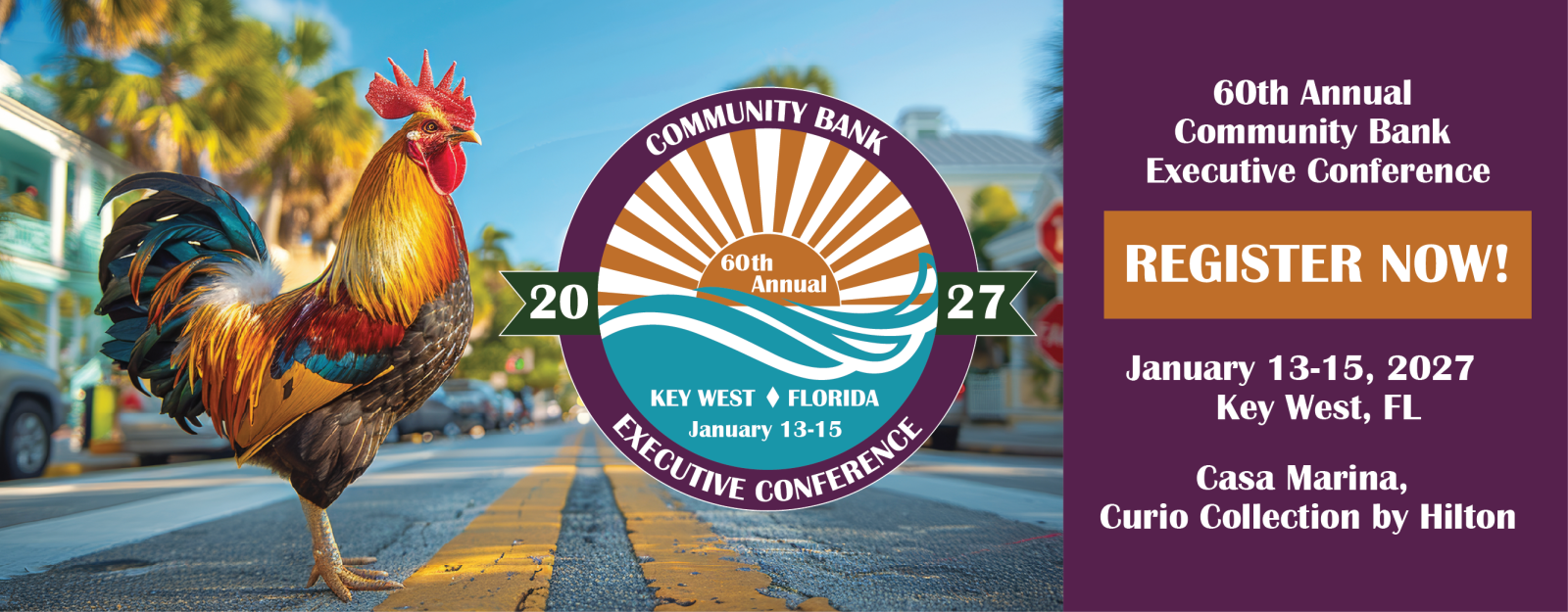
60th Annual Community Bank Executive Conference
Venue Location: Casa Marina Key West, Curio Collection by Hilton
1500 Reynolds St, Key West, FL 33040
Wednesday, January 13 - 15th, 2027
Program Description: Now celebrating its 60th year, the Community Bank Executive Conference is the nation's premier leadership conference for independent community banks with $500 million to $10 billion in assets. Executives from nearly a dozen states gather with one common purpose—to strengthen their institutions and preserve their independence.
Remaining independent requires more than strong financial performance. It demands intentional planning for leadership succession, board succession, shareholder succession, and long-term strategy. Designed exclusively for community bank executives and directors, this conference delivers practical insights from nationally recognized experts and successful bank leaders committed to the future of independent banking.
Equally valuable are the relationships you'll build with fellow CEOs, directors, and industry partners who understand the challenges and opportunities facing independent community banks. The conversations you have here often become tomorrow's strategies and partnerships.
The future of your bank will be shaped by the choices you make today. Join us for this milestone 60th Community Bank Executive Conference and invest in the leadership, relationships, and strategies that will protect your bank's independence for generations to come.
World-class executive education.
Meaningful peer connections.
An unforgettable destination.
Agenda
Wednesday, January 13
Thursday, January 14
8:00 AM Session 1: Creating a Culture of Coaching
Develop Your People. Keep Your Talent. Scale Your Impact.
The best people want more than a job. They want to grow. Yet in many organizations, development depends on whether an employee happens to have a great manager with the time and skill to coach.
What if coaching became part of your culture?
In this interactive keynote, Dr. Julie Bell introduces a simple, repeatable approach for building coaching and development into the everyday rhythm of work. Through brief, intentional conversations, leaders can reinforce priorities, create accountability, develop talent, and strengthen connections across the organization—without adding another hour-long meeting to the calendar.
Participants will experience this coaching approach firsthand and learn how focused, 15-minute conversations can help managers become better coaches and create a culture where developing people is everyone's responsibility.
Because retaining great people isn't just about compensation or benefits. People stay where they are growing.
Participants will leave with a practical framework they can immediately use to:
- Create a culture where coaching and development happen consistently
- Develop more people without adding layers of programs or meetings
- Increase connection, accountability, and engagement
- Strengthen leadership at every level of the organization
- Reinforce organizational priorities and key messages
- Make employee development part of the way work gets done
Speaker: Dr. Julie Bell, Chartwell Partners
Dr. Julie Bell joined Chartwell Partners to lead the firm’s suite of Leadership Advisory services which includes Success Planning, Executive Assessments, Board Advisory, Executive Coaching and Keynote Speaking. She brings a 25-year track record of partnering with organizations and individuals in their quest to maximize performance. Dr. Julie is a leader in the People Intelligence™ industry with her development of CP Power 4 Assessment, Relationship Based Coaching and Technology Assisted Coaching.
Julie earned her Bachelor of Science in Psychology from Oklahoma State University and a Master and Doctorate of Sport Psychology from the University of Virginia, where she studied under Dr. Bob Rotella.
She has served as adjunct faculty at Oklahoma State University and Southern Methodist University. Her book, Performance Intelligence at Work, was published in 2009 by McGraw-Hill. She lives on the lake in Athens, TX with her husband, Nelson, and 3 children when they are home from college.
9:00 AM Session 2: What Can the Executive Team Do to Proactively Manage Cybersecurity?
Cybersecurity is no longer simply an IT issue. It is a business risk that requires executive leadership. This session will help community bank executives cut through the noise and focus on what matters most: building strong cybersecurity fundamentals, preparing for an AI-driven threat landscape, and safely enabling AI within the bank. Attendees will leave with a practical framework for how executives can Defend, Enable, and Govern in a rapidly changing environment.
Speaker: Chris Bedel, Bedel Security
Chris is an information security professional and entrepreneur, who oddly enjoys things like risk assessments, incident response walkthroughs, and security awareness training. He was the Information Security Officer for 8 years at a community bank, where he was integral in achieving 82% growth in assets while more than doubling net income during his tenure as ISO.
Looking for new challenges, Chris started Bedel Security® in March 2015, where they help banks and credit unions with their information security programs by providing services to fill and/or support the CISO and ISO functions.
He has a Business degree from Purdue University with a minor in MIS and holds the CISM certification.
When not working on his business, Chris stays busy chasing after 4 kids and other animals with his wife on their 50-acre farm in Indiana.
10:00 AM Session 3: Community Banks Well Positioned for 2027
Last year, the economic backdrop for community banks was favorable by most any metric. Interest rates hitting multi-decade highs was a positive for everything on the income statement and balance sheet, with the one exception of bond prices. Otherwise, NIM’s are very favorable, and credit quality remains outstanding. Also well-contained are risk metrics such as Asset/Liability Management. We will look at the key determinants of profitability as 2027 commences, including the bond market’s expectations for inflation and monetary policy.
Speaker: Jim Reber, The Baker Group
Jim Reber is Managing Director ICBA Relations for The Baker Group. He is a frequent speaker and lecturer at bank investment seminars and workshops. Jim has written over 350 investment columns for Independent Banker magazine and trade publications. He is on the faculty at Barret School of Banking in Memphis, TN, and serves on the Board of Regents and a term as Chairman. Jim is a Certified Public Accountant and a Chartered Financial Analyst, and is a graduate of Christian Brothers University, where he served on the Board of Trustees as Chairman of the Finance Committee and University Treasurer.
10:45 AM Session 4: Peer Sourced Round Table Discussions
Expand your network and share your team’s experiences during HUB | Taylor Advisors facilitated roundtable discussions with your industry peers. This is your chance to gain both new perspectives and lessons learned on a variety of topics that affect your bank’s ALCO committee.
Speaker: Omar Hinojosa, CFA, Managing Partner, HUB | Taylor Advisors
Omar leads the depository institution consulting team and works with clients nationally to reimagine their balance sheet management process. Omar previously worked in officer roles for banks based in Texas. He is a frequent national speaker for banking industry programs and faculty lecturer for ABA’s Stonier GSB. Omar has authored educational articles for publications across the country.
11:30 AM Session 5: Navigating the Path to Independence
Building the Structure, Strength and Strategy to Remain Independent
Remaining independent doesn’t happen by accident. As community banks grow, they face increasing pressure from rising operating costs, technology investments, regulatory demands, succession challenges, competition for talent and an active merger and acquisition environment. The banks that successfully navigate these challenges are intentional about building an organization capable of sustaining independence.
This two-part executive session will examine the strategies and structural decisions that can help community banks remain strong, relevant and independent for the long term.
Participants will explore how to strengthen the organization behind the bank—including the effective use of the bank holding company, corporate and governance structures, capital planning, shareholder considerations and other strategic tools that can provide greater flexibility as the institution grows.
The session will also examine today’s community bank M&A environment and how boards and executive teams should prepare before an offer ever arrives. Discussion will include responding to unsolicited offers, dealing with aggressive buyers, understanding fiduciary considerations and positioning the organization so that remaining independent continues to be a viable strategic choice.
Finally, the program will examine the growing role of credit unions in community bank acquisitions, including the structural and tax differences that can affect how those transactions are valued and what an offer ultimately means for shareholders, employees and the communities involved.
Designed specifically for community bank CEOs and senior executives, this interactive and engaging session will provide practical strategies leaders can take back to their boards and management teams to strengthen their institutions today while preserving their ability to choose their own path tomorrow.
Because independence is more than a decision. It is something you build.
Speaker: Philip Smith, Gerrish Smith Tuck
Mr. Smith is Chairman of the Board of Directors and Chief Executive Officer of the Memphis-based law firm of Gerrish Smith Tuck, PC, and its affiliated bank consulting firm, Gerrish Smith Tuck Consultants, LLC. Mr. Smith's legal and consulting practice places special emphasis on bank mergers and acquisitions, financial analysis, acquisition and ownership planning for boards of directors, strategic planning for boards of directors, regulatory matters, bank holding company formations and use, securities law concerns, new bank formations, S corporations, going private transactions, and other matters of importance to banks and financial institutions. He is a frequent speaker to boards of directors and a presenter at numerous banking seminars. He received his undergraduate business degree and Master of Business Administration degree from the Fogelman School of Business and Economics at The University of Memphis and his law degree from the Cecil C. Humphreys School of Law at The University of Memphis. He is authoring a monthly electronic newsletter, The Board Chair Forum Newsletter, which discusses key topics impacting financial institutions and, specifically, the role of the Chairman. Mr. Smith is a Summa Cum Laude graduate of the Barret School of Banking where he has been a member of the faculty. He also is or has been a member of the faculty of the Pacific Coast Banking School, the Colorado Graduate School of Banking, the Southwestern Graduate School of Banking and the Wisconsin Graduate School of Banking.
Friday, January 15
8:00 AM Session 1: Trust No One: AI, Cyber Events & Fraud in the New Era of Banking
Exploring Emerging Privacy Threats, The New Face of Fraud, Cyber Attacks, and Ransomware with Practical Risk Management Solutions
The threats facing financial institutions are evolving faster than many banks’ risk-management strategies. From sophisticated social engineering and AI-enabled wire fraud to ransomware, privacy breaches, and increasingly organized threat actors, today’s risks extend far beyond traditional cybersecurity.
This presentation will explore how criminals are leveraging technology to target banks of all sizes and will include practical steps bank leaders, employees, and board members can take to spot vulnerabilities before it’s too late.
Topics will include:
- AI & Banking Risk: How AI is creating new opportunities for fraud, impersonation, social engineering and operational mistakes.
- Wire & Payment Fraud: Emerging schemes targeting employees, vendors and customers, including AI-enhanced business email compromise and deepfakes.
- Cyber Liability: What happens when a bank experiences ransomware, a system compromise, or a significant business interruption.
- Privacy Events: Understanding the financial, regulatory, and reputational consequences of a privacy breach and the resulting liability.
- Insurance Implications: Where Cyber, Bond, D&O and other coverages may or may NOT respond.
- Risk Management & Prevention – Practical steps banks can take through employee education, internal controls, incident response planning, and board oversight.
Speaker: Katie Gazley, Principal, GAD Insurance
Katie Gazley brings approximately 20 years of experience working exclusively with financial institutions, helping banks simplify complex insurance and risk-management issues and better understand where their programs may have vulnerabilities.
10:15 AM Session 2: The 2027 Legislative & Regulatory Outlook: A View from Washington
As a new year begins, legislative and regulatory developments in Washington will continue to shape the operating environment for community banks. Join Paul Merski of the Independent Community Bankers of America (ICBA) for a timely look at the latest policy discussions, legislative priorities and regulatory developments impacting the industry. This session will provide insight into the evolving political and regulatory landscape, ICBA’s advocacy efforts and what community bank leaders should be watching in the months ahead. With an agenda shaped by the latest developments in Washington, attendees will gain valuable perspective on the issues and opportunities that could influence community banking in 2027.
Speaker: Paul Merski, ICBA
Paul Merski is Executive Vice President, Congressional Relations for the Independent Community Bankers of America® (ICBA). Merski leads ICBA’s congressional relations teams and oversees ICBA’s legislative and political action committee initiatives.
Merski has more than 30 years of experience in legislative and economic policy development and analysis for some of the most prominent organizations in Washington, D.C. Before joining ICBA, Merski served on Capitol Hill as the chief economist for the Joint Economic Committee and as senior tax and banking policy advisor to U.S. Senator Connie Mack. Merski also was director of fiscal policy for Citizens for a Sound Economy, director of fiscal affairs for the Tax Foundation and served as an economist for the Commerce Department’s Bureau of Economic Analysis.
A frequent speaker at industry events, Merski is often quoted in The Wall Street Journal, Politico, American Banker, The Hill, and other trade publications and has appeared on the Fox Business Network and Bloomberg Television. Merski has been named a top Washington lobbyist every year since 2018 by “The Hill” publication.
Merski received a BA in economics from The Catholic University of America, completed graduate work in economics at George Washington University, and earned his MBA with top honors from George Mason University.
11:15 AM Session 3: Navigating the Path to Independence Part 2
Building the Structure, Strength and Strategy to Remain Independent
Remaining independent doesn’t happen by accident. As community banks grow, they face increasing pressure from rising operating costs, technology investments, regulatory demands, succession challenges, competition for talent and an active merger and acquisition environment. The banks that successfully navigate these challenges are intentional about building an organization capable of sustaining independence.
This two-part executive session will examine the strategies and structural decisions that can help community banks remain strong, relevant and independent for the long term.
Participants will explore how to strengthen the organization behind the bank—including the effective use of the bank holding company, corporate and governance structures, capital planning, shareholder considerations and other strategic tools that can provide greater flexibility as the institution grows.
The session will also examine today’s community bank M&A environment and how boards and executive teams should prepare before an offer ever arrives. Discussion will include responding to unsolicited offers, dealing with aggressive buyers, understanding fiduciary considerations and positioning the organization so that remaining independent continues to be a viable strategic choice.
Finally, the program will examine the growing role of credit unions in community bank acquisitions, including the structural and tax differences that can affect how those transactions are valued and what an offer ultimately means for shareholders, employees and the communities involved.
Designed specifically for community bank CEOs and senior executives, this interactive and engaging session will provide practical strategies leaders can take back to their boards and management teams to strengthen their institutions today while preserving their ability to choose their own path tomorrow.
Because independence is more than a decision. It is something you build.
Speaker: Philip Smith, Gerrish Smith Tuck
Mr. Smith is Chairman of the Board of Directors and Chief Executive Officer of the Memphis-based law firm of Gerrish Smith Tuck, PC, and its affiliated bank consulting firm, Gerrish Smith Tuck Consultants, LLC. Mr. Smith's legal and consulting practice places special emphasis on bank mergers and acquisitions, financial analysis, acquisition and ownership planning for boards of directors, strategic planning for boards of directors, regulatory matters, bank holding company formations and use, securities law concerns, new bank formations, S corporations, going private transactions, and other matters of importance to banks and financial institutions. He is a frequent speaker to boards of directors and a presenter at numerous banking seminars. He received his undergraduate business degree and Master of Business Administration degree from the Fogelman School of Business and Economics at The University of Memphis and his law degree from the Cecil C. Humphreys School of Law at The University of Memphis. He is authoring a monthly electronic newsletter, The Board Chair Forum Newsletter, which discusses key topics impacting financial institutions and, specifically, the role of the Chairman. Mr. Smith is a Summa Cum Laude graduate of the Barret School of Banking where he has been a member of the faculty. He also is or has been a member of the faculty of the Pacific Coast Banking School, the Colorado Graduate School of Banking, the Southwestern Graduate School of Banking and the Wisconsin Graduate School of Banking.

